Track truth, not fields
How do you know what is really shipped? Statuses, acceptances, value, decisions and a journal that keep the graph honest.
A product map is only useful if you can trust it. A screen marked "done" that half the platforms never got is worse than no map at all. Arkaik tracks truth in layers, each one answering the question the previous one couldn't.
It starts with a shared vocabulary for where things stand, per platform.

Where is this thing, really, on each platform? One lifecycle, a blocked flag and a stage axis.
A status is a claim. Acceptances are the proof: testable promises, checked platform by platform, moved forward by the pull requests that fulfil them.
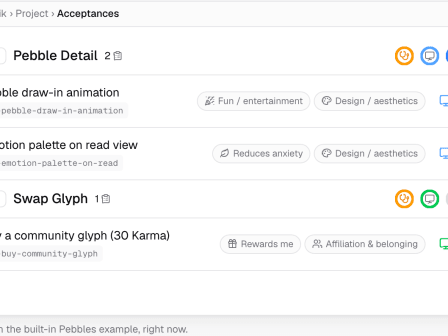
Given, When, Then, checked on every platform. The promise behind each screen, and the gaps between platforms.
Shipped isn't the same as valuable. The value pyramid tells you which kinds of value your product actually delivers today.
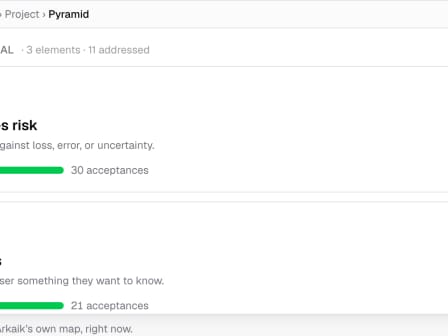
Thirty elements of value in four tiers, each with a gauge of how much you actually deliver.
Behind every "why is it like this?" there's a choice. Decisions live in the graph too, wired to what they changed.

Why is it built this way? ADR-style decisions wired to what they replaced, produced and touched.
And underneath it all, a journal that never forgets. Every change is an event; the changelog, the history and the deliverables are just ways of reading it.

An append-only log of every change. The changelog, the history and the deliverables are all read from it.
Journal
- Pull request deliverablesMilestone
- Milestones as timelinesMilestone
- Design and Delivery splitMilestone
- Pull requests move acceptancesMilestone
- The value pyramid landsMilestone
- The journal landsMilestone